The coverage of the terror attacks showed that when the media becomes a purely business enterprise, news becomes a commodity, serving the interests of the few. It ceases to be the guardian of democracy or the protector of public interest.
...It is shocking that a slogan like “enough is enough” is bandied about in the media now after a terror attack. The moral angst of the media could not be roused all these years even when 1.5 lakh farmers committed suicide in a period of mere eight years from 1997 to 2005. How many channels did exclusive “breaking news” stories when India, the second fastest growing economy in the world, secured the 94th position, behind even Nepal, in the Global Hunger Index Report? Where were the Shobha Des and Ness Wadias then, who are now out on the streets mouthing revolutionary slogans like “boycott taxes”? Where were the candle light vigils and demonstrations when policemen rode on a motorbike with a human being tied to it? Or when a father and a child were crushed under a bus after being thrown off it for not being able to pay two rupees for the ticket? For the 40 crore Indians who live like worms, the prospect of being shot dead by terrorists would seem like a dream come true. At least it is more glorious and patriotic than swallowing pesticide!...
The Mumbai attacks have been dubbed 'India's 9/11', and there are calls for a 9/11-style response, including an attack on Pakistan. Instead, the country must fight terrorism with justice, or face civil war.
...We're told one of these hotels is an icon of the city of Mumbai. That's absolutely true. It's an icon of the easy, obscene injustice that ordinary Indians endure every day. On a day when the newspapers were full of moving obituaries by beautiful people about the hotel rooms they had stayed in, the gourmet restaurants they loved (ironically one was called Kandahar), and the staff who served them, a small box on the top left-hand corner in the inner pages of a national newspaper (sponsored by a pizza company I think) said "Hungry, kya?" (Hungry eh?). It then, with the best of intentions I'm sure, informed its readers that on the international hunger index, India ranked below Sudan and Somalia. But of course this isn't that war. That one's still being fought in the Dalit bastis of our villages, on the banks of the Narmada and the Koel Karo rivers; in the rubber estate in Chengara; in the villages of Nandigram, Singur, Chattisgarh, Jharkhand, Orissa, Lalgarh in West Bengal and the slums and shantytowns of our gigantic cities...
...In this nuclear subcontinent that context is partition. The Radcliffe Line, which separated India and Pakistan and tore through states, districts, villages, fields, communities, water systems, homes and families, was drawn virtually overnight. It was Britain's final, parting kick to us. Partition triggered the massacre of more than a million people and the largest migration of a human population in contemporary history. Eight million people, Hindus fleeing the new Pakistan, Muslims fleeing the new kind of India left their homes with nothing but the clothes on their backs...
...Through the endless hours of analysis and the endless op-ed essays, in India at least there has been very little mention of the elephants in the room: Kashmir, Gujarat and the demolition of the Babri Masjid. Instead we had retired diplomats and strategic experts debate the pros and cons of a war against Pakistan. We had the rich threatening not to pay their taxes unless their security was guaranteed (is it alright for the poor to remain unprotected?). We had people suggest that the government step down and each state in India be handed over to a separate corporation. We had the death of former prime minister VP Singh, the hero of Dalits and lower castes and villain of Upper caste Hindus pass without a mention...
...The only way to contain (it would be naïve to say end) terrorism is to look at the monster in the mirror. We're standing at a fork in the road. One sign says Justice, the other Civil War. There's no third sign and there's no going back. Choose.
RITIKA PASSI wonders at the depletion of scarce water resources by Bollywood
THE ENTERTAINMENT INDUSTRY is expected to grow faster than the GDP. By 2020, India could run out of drinking water. What’s the connection? Gone are the days when you could cite continuously flushing toilets and leaking taps as causes of water shortage: The newest and much more glamorous culprit is our healthy, wealthy, but not so wise Bollywood industry.
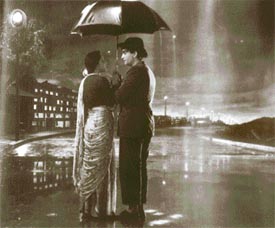
India’s very own tinsel town has a major hand in depleting precious water resources. Think of all the rain sequences in Indian movies, particularly the rain dances. It’s estimated that around 28,000 litres of water are needed for a single rain sequence in a film. And that too pure water, since actors fear rashes. The amount is enough to fulfill the water requirements of 30 families for four weeks, according to an art director interviewed by a leading daily. Puts the leaking DJB water tankers to shame.
And before you go, “What about movies like Titanic and Poseidon?”, remember the words ‘special effects’, which are much more advanced there than here?
So while in Gujarat nearly 4,000 villages suffer from severe water scarcity every year, not to fear — the scantily clad damsel in distress in a Yash Raj Production will be sufficiently drenched to artfully capture her nubile form enticing her indifferent lover through yet another song. While Bollywood may indeed have given us evergreen rain song numbers, like the more modest pyaar hua ikraar hua and the sizzling tip tip barsa paani, it’s time to ask whether it’s worth the environmental fallout.
And these are just the water woes. Consider this: Hollywood spews around 2,000 tonnes of CO2 for every average big-budget movie. Moreover, 8,00,000 sheets of paper are wasted by the average blockbuster. Bollywood can’t be far behind, considering how well we like to compete with our western counterpart. And it’s also said that a one-minute shot eats up 120 KW. Aishwarya Rai, Amitabh Bachchan and the likes may have joined unforgettable world tours to highlight climate change; Vidya Balan may have taken part in the illustrious plantation drive on World Environment Day. But the fact remains — Bollywood is a ‘dirty’ business.
Tip Tip Barsa Pani is a famous rain song from the Bollywood movie, Mohra (1994) and the phrase literally means the sound(tip tip) of water dripping.
(Ritika Passi studies at the Amity School of Communication, Amity University)
From Tehelka Magazine, Vol 5, Issue 48, Dated Dec 06, 2008
It is worth learning this: Al-Qaeda was the biggest beneficiary of the “response” of the United States to 9/11 alongside U.S. corporations. America’s “War on Terror” produced far more terrorism in the world than there had been prior to that response.
Of all the arguments making the rounds after the appalling slaughter of 180 people in Mumbai, the worst is this: that India should learn from the United States about how to respond to such terror. “Look at the USA,” goes the refrain, “after 9/11 has there been another attack on U.S. soil?” In short, Washington’s measures after that tragedy were so effective, nobody ever bothered them again. This knocks at the doors of insanity. The U.S. “ ;response” does stand out as worth learning from. There is very little it did not get wrong.
Around 3,000 people lost their lives in the dreadful attacks on the World Trade Centre in New York on 9 /11. America’s response was to go to war. It launched two wars, one of against a country that had not a single link to the events of 9/11. Close to a million human beings have lost their lives in that response. That includes 4,000 U.S. troops in Iraq and nearly 1,000 in Afghanistan. That is apart from several hundred thousand Iraqis losing their lives. Countless Afghans die each month, as one of the world’s poorest states sinks deeper into devastation. (Afghanistan, for U.S. liberals, is “the good war.”) Millions have suffered dislocation and deprivation in the region.